


News
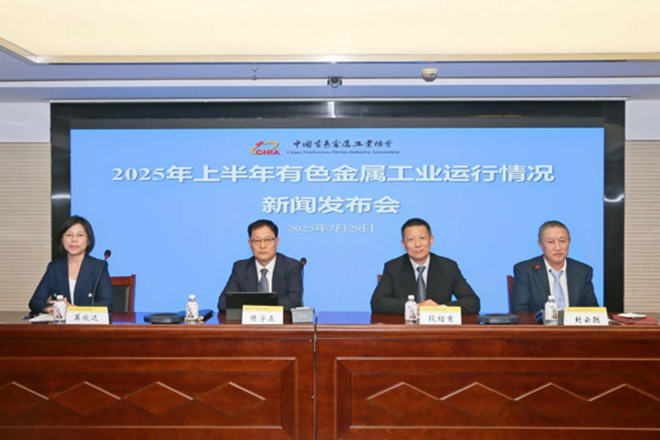
On July 29, the China Nonferrous Metals Industry Association (CNMA) held a press conference on the performance of the nonferrous metals industry in the first half of 2025, held in a combination of offline and online formats. Chen Xuesen, member of the Standing Committee of the CNMA Party Committee, Vice President, and spokesperson, reported on the performance of my country's nonferrous metals industry in the first half of the year and, along with heads of relevant departments, answered questions from media reporters and company representatives.
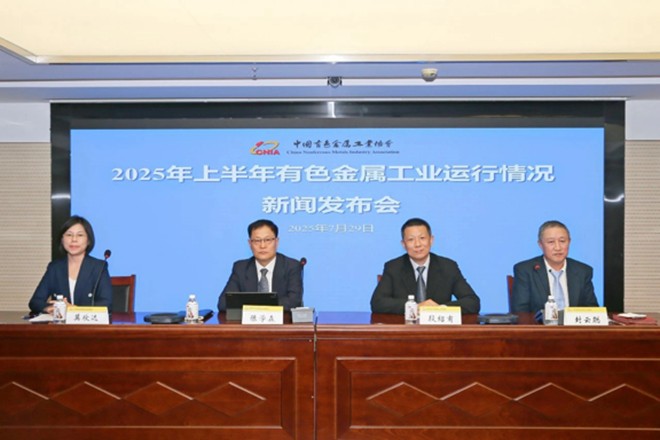
Chen Xuesen stated that as a key support for the development of new-quality productive forces, my country's nonferrous metals industry operated smoothly overall in the first half of the year, with production maintaining reasonable growth and investment maintaining double-digit growth. Revenues and profits of enterprises above designated size increased compared to the same period last year, and imports of major resources increased. Although prices of new energy metals declined compared to the same period last year, domestic market prices for major metals and rare metals such as gold remained strong.
First, nonferrous metal production maintained overall growth. Data from the National Bureau of Statistics showed that in the first half of the year, the added value of nonferrous industries above designated size increased by 7.6% year-on-year, 1.2 percentage points higher than the national growth rate of added value of industries above designated size, demonstrating strong resilience based on a strong start in the first quarter. In the first half of the year, the output of ten commonly used nonferrous metals reached 40.319 million tons, a year-on-year increase of 2.9%. Of this total, refined copper output reached 7.363 million tons, and electrolytic aluminum output reached 22.379 million tons, representing year-on-year increases of 9.5% and 3.3%, respectively. These two outputs were the main drivers of the growth in the output of the ten commonly used nonferrous metals. The output of six types of mineral metals reached 3.155 million tons, a year-on-year increase of 5.5%; alumina output reached 45.151 million tons, a year-on-year increase of 9.3%; copper output reached 11.765 million tons, a year-on-year increase of 3.7%; and aluminum output reached 32.768 million tons, a year-on-year increase of 1.3%. According to statistics from relevant branches of the China Nonferrous Metals Industry Association, among new energy metals, industrial silicon output reached 2.183 million tons, a year-on-year decrease of 5.5%; electrolytic nickel output reached 173,000 tons, a year-on-year decrease of 2.1%; refined cobalt output reached 94,000 tons, a year-on-year increase of 16.1%; and lithium carbonate output reached 386,000 tons, a year-on-year increase of 29.0%.
Secondly, fixed asset investment maintained rapid double-digit growth. In the first half of the year, fixed asset investment in the nonferrous metals industry increased by 16.1% compared to the same period last year. Building on a higher base in the same period last year, this further growth exceeded the national industrial investment growth rate by 5.8 percentage points. Specifically, fixed asset investment in the mining and smelting industry increased by 46.2%, while fixed asset investment in the smelting and rolling processing industry increased by 9.1%. At the same time, private investment has been fully unleashed. In the first half of the year, private fixed asset investment in my country's non-ferrous metals sector grew by 12.1% year-on-year. Specifically, private investment in non-ferrous metal mining and dressing increased by 32.1%, and private investment in smelting and rolling processing increased by 7.6%.
Third, total foreign trade maintained growth. In the first half of the year, despite an 11% decline in the trade volume of non-ferrous metal products and manufactured goods between China and the United States, total non-ferrous metal imports and exports still reached US$192.49 billion, a year-on-year increase of 2.4%. Imports totaled US$151.92 billion, a year-on-year decrease of 3.0%, while exports totaled US$40.57 billion, a year-on-year increase of 29.1%. The export growth was primarily driven by gold products. Among the major import and export products, imports of copper ore and concentrates reached 14.754 million tons, a year-on-year increase of 6.4%; physical imports of bauxite reached 103.25 million tons, a year-on-year increase of 33.6%; imports of unwrought copper and copper products reached 2.633 million tons, a year-on-year decrease of 4.6%; and exports of unwrought aluminum and aluminum products reached 2.918 million tons, a year-on-year decrease of 8.0%. Imports and exports of major new energy metals continued to grow. Lithium carbonate imports reached 118,000 tons, a year-on-year increase of 10.7%; unwrought nickel exports reached 91,000 tons, a 100% year-on-year increase; industrial silicon exports reached 341,000 tons, a year-on-year decrease of 6.6%; and rare earth exports reached 33,000 tons, a year-on-year increase of 11.9%.
Fourth, base metal prices rose, while prices of new energy non-ferrous metals remained low. In the first half of the year, the market performance of common non-ferrous metals and new energy non-ferrous metals diverged significantly. Prices of most non-ferrous metals continued their upward trend, with the average domestic spot prices of copper and zinc reaching a three-year high. In the domestic spot market, the average price of copper was 77,613 yuan/ton, a year-on-year increase of 4.2%; the average price of aluminum was 20,312 yuan/ton, a year-on-year increase of 2.6%; the average price of lead was 16,952 yuan/ton, a year-on-year decrease of 0.5%; and the average price of zinc was 23,305 yuan/ton, a year-on-year increase of 5.4%. Driven by safe-haven demand, the average price of domestic gold was 725.6 yuan/gram, a year-on-year increase of 46.8%. Prices of new energy non-ferrous metals are fluctuating at a low point. In the domestic spot market, the average price of industrial silicon was 10,000 yuan/ton, a year-on-year decrease of 28.7%; the average price of battery-grade lithium carbonate was 71,000 yuan/ton, a year-on-year decrease of 31.9%; the average price of nickel was 126,000 yuan/ton, a year-on-year decrease of 8.5%; and the average price of cobalt was 207,000 yuan/ton, a year-on-year decrease of 7.3%.
Fifth, the revenue and profits of non-ferrous metal enterprises above designated size continued to grow. Driven by the strengthening and expansion of policies such as the "Two New" and "Two Heavy" initiatives, the fundamentals of the non-ferrous industry's stable economic growth remain unchanged. In the first half of the year, non-ferrous metal industrial enterprises above designated size achieved operating revenue of 4,793.25 billion yuan, a year-on-year increase of 14.9%; and total profits of 217.85 billion yuan, a year-on-year increase of 15.0%. Among them, the non-ferrous mining and dressing industry achieved total profits of 59.55 billion yuan, a year-on-year increase of 40.3%; the smelting and rolling processing industry achieved total profits of 158.31 billion yuan, a year-on-year increase of 7.8%. The operating income profit margin of nonferrous metal enterprises above designated size was 4.55%, a slight year-on-year increase. Specifically, the operating income profit margin of the nonferrous mining and dressing industry was 30.03%, a year-on-year increase of 5.53 percentage points; the operating income profit margin of the smelting and rolling processing industry was 3.45%, a year-on-year decrease of 0.22 percentage points. The return on assets was 6.98%, a year-on-year increase of 0.61 percentage points. The debt-to-asset ratio was 59.86%, a year-on-year decrease of 0.63 percentage points.
Chen Xuesen provided an outlook for the full-year performance of the nonferrous metals industry based on the international and domestic environment and operating characteristics of the industry in the first half of the year. Internationally, the international environment is complex and severe, with multiple risks compounding the disruption. Intensified commodity price volatility is putting pressure on business operations. Uncertainty surrounding the Sino-US trade friction will further increase pressure on the industry's trade with the US, entrepot trade, industrial chain and supply chain layout, investment, and stable operations. Domestically, the domestic economy demonstrates resilience, with endogenous momentum supporting demand. The "New Three Things" initiative and innovation-driven development are supporting market growth. The China Nonferrous Metals Industry Association (CNMA) predicts that the added value of the nonferrous metals industry will increase by approximately 5% in 2025, with the output of ten common nonferrous metals projected to increase by 2% to 3% year-on-year. Prices of common nonferrous metals such as copper and aluminum will remain high and volatile, while prices of industrial silicon and lithium carbonate will remain low. Imports of copper concentrate and bauxite will continue to grow year-on-year, while exports of aluminum and aluminum products will decline. Revenue and profits of large-scale nonferrous metal enterprises are expected to maintain growth compared to the same period last year, but the rate of increase may narrow.
Chen Xuesen stated that the CNMA will resolutely implement the decisions and deployments of the CPC Central Committee, based on its mandate, and fully utilize various national policies, both existing and incremental, to promote high-quality development of the industry. First, continue to focus on stabilizing growth and laying a solid foundation for a strong start to the 15th Five-Year Plan. Second, carefully plan the 15th Five-Year Development Plan and leverage its guiding role in industry development. Third, continue to strengthen industry self-discipline and effectively curb "involutionary" and vicious competition. Fourth, systematically review the practical experience of export control policies for dual-use rare metal items and continuously improve and optimize these policies. Faced with new developments, challenges, and structures, the nonferrous metals industry will adhere to the guidance of Xi Jinping Thought on Socialism with Chinese Characteristics for a New Era, thoroughly implement the spirit of the 20th National Congress of the Communist Party of China and the Second and Third Plenary Sessions of the 20th Central Committee, uphold and strengthen the Party's overall leadership, firmly grasp the primary task of high-quality development, and maintain confidence in development. In the process of accelerating high-quality development of the industry, the China Nonferrous Metals Industry Association will seize the 15th Five-Year Plan as an opportunity to continuously improve the quality and efficiency of the industry's economic operations, increase coordination and cooperation with the government and enterprises, and jointly promote the development of the nonferrous metals industry towards high-end, intelligent, and green development, contributing to the comprehensive construction of a modern socialist country.
information center
- ▶ Focus on September 3! Tiananmen Square's new layout for the Victory Day commemoration: an upgraded viewing experience and rich symbolism.
- ▶ The application technology of used refractory materials in iron trough has a bright future
- ▶ Huang Runqiu, Minister of Ecology and Environment: Steel mills that have undergone ultra-low emission transformation are no longer what they used to be.
- ▶ The non-ferrous metals industry saw steady growth in profitability in the first half of the year
- ▶ US expands 50% tariffs on steel and aluminum imports
- ▶ 2025 Cold Rolled Strip Technology Exchange Conference was successfully held
Message